Designing a Productivity System that Feels Human
Problem
Most productivity tools are optimized for efficiency, not emotional sustainability.
They assume users operate at a constant level of motivation, leading to:
They assume users operate at a constant level of motivation, leading to:
- Cognitive overload from rigid task systems
- Guilt-driven productivity cycles (miss task - fall behind - disengage)
- Low retention due to emotional fatigue
“productivity apps neglect emotional well-being”
Core Problem Statement:
Users need a way to manage tasks without emotional burnout
because current systems fail to adapt to fluctuating motivation and mental states.
Users need a way to manage tasks without emotional burnout
because current systems fail to adapt to fluctuating motivation and mental states.
Constraints
1. Behavioral Constraint
Users are inconsistent. Designing for “ideal productivity” would fail in real-world usage.
Users are inconsistent. Designing for “ideal productivity” would fail in real-world usage.
2. Cognitive Load Constraint
Overly complex systems increase drop-off.
Reducing decision-making at every interaction is a must.
Overly complex systems increase drop-off.
Reducing decision-making at every interaction is a must.
3. System Integration Constraint
Pebl combines task management, mood tracking
and community interaction
Pebl combines task management, mood tracking
and community interaction
Balancing these without fragmentation was critical.
4. Time & Scope Constraint
Academic timeline limited the depth of usability testing
and a full technical validation of adaptive systems
Academic timeline limited the depth of usability testing
and a full technical validation of adaptive systems
Process
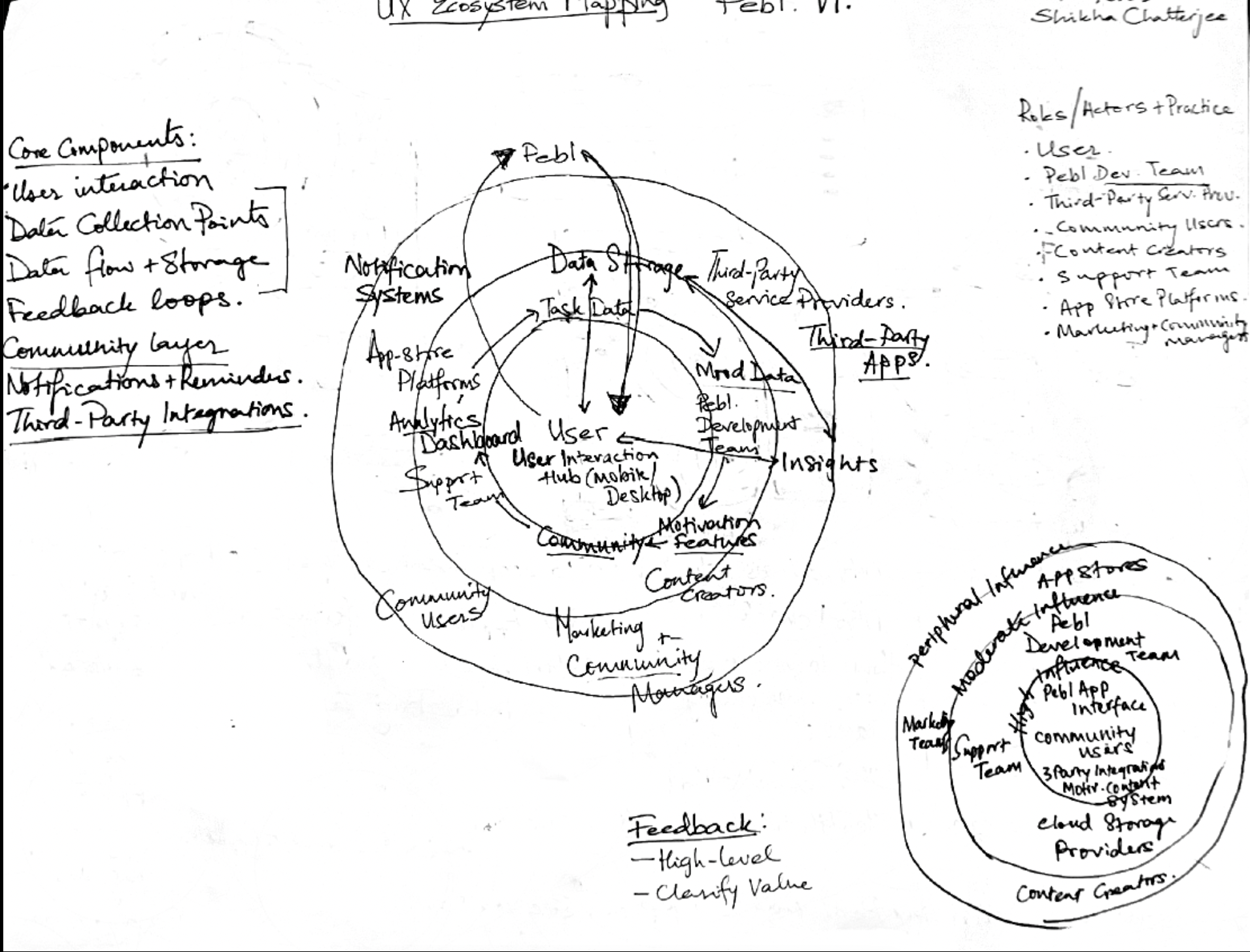
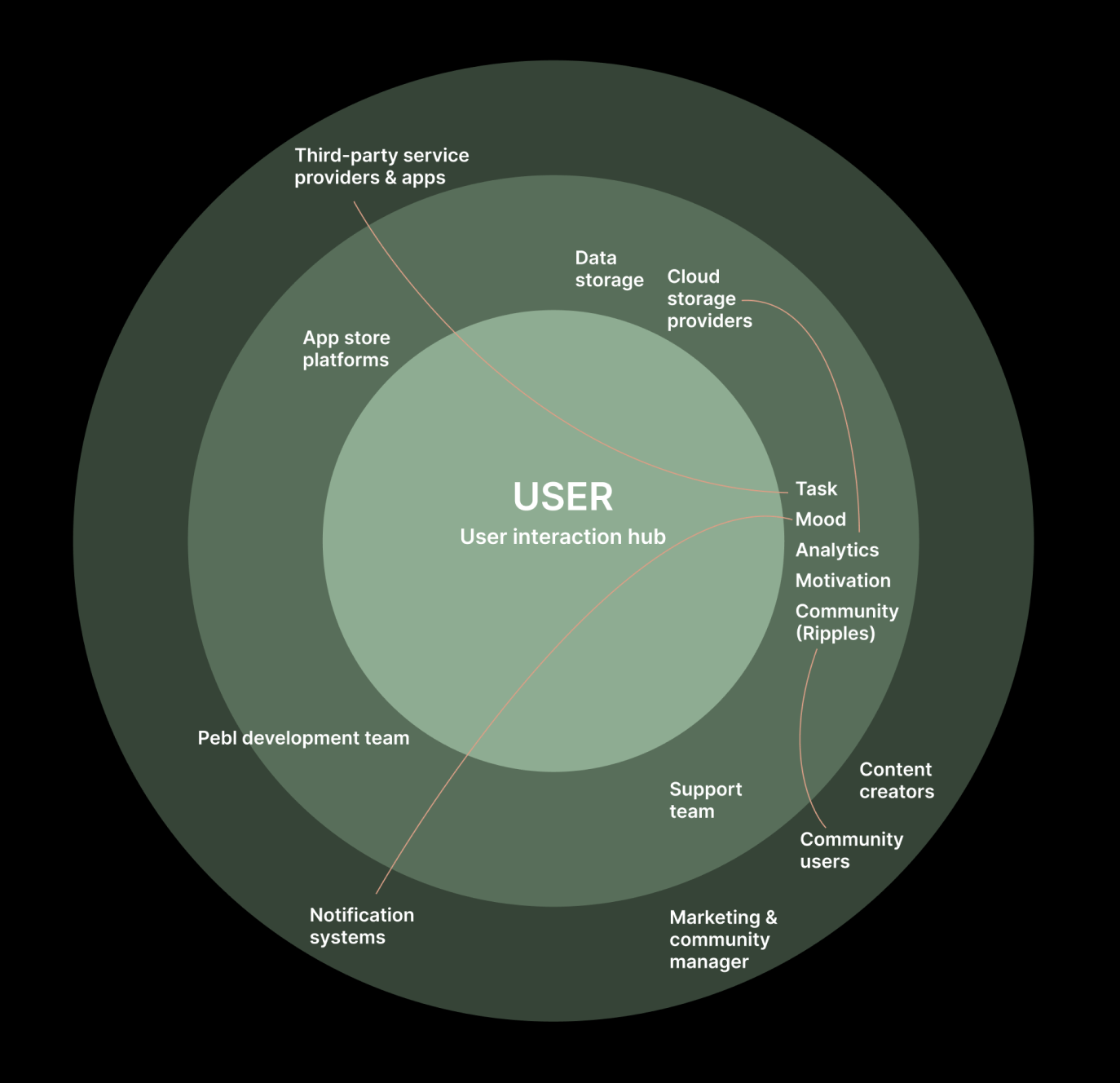
1. Defining the Ecosystem
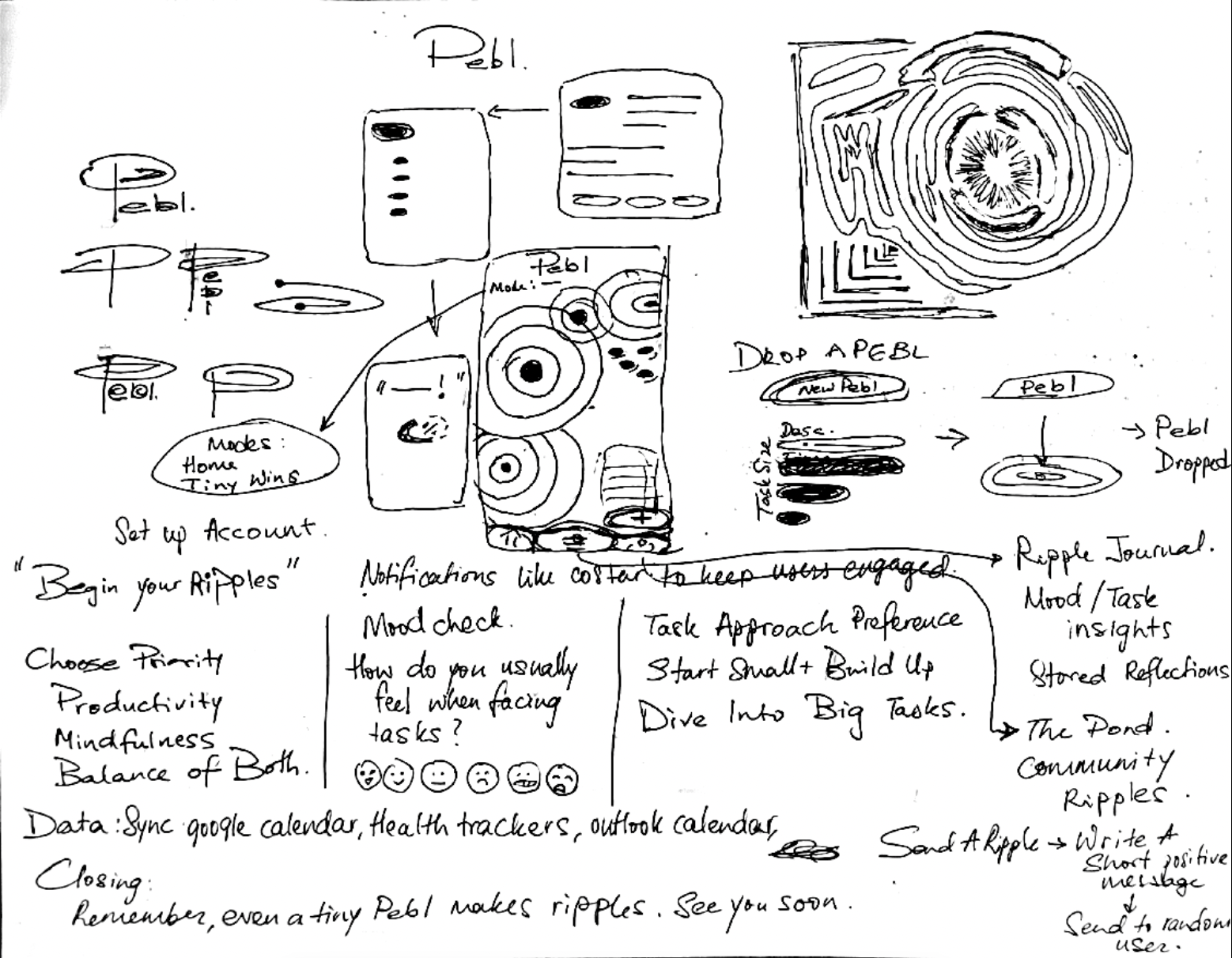
The UX ecosystem maps Pebl as a behavioral system involving mood analytics, task systems, community (“Ripple”) interaction and external integrations (notifications, cloud, etc.)
Productivity becomes an ecosystem of feedback loops.
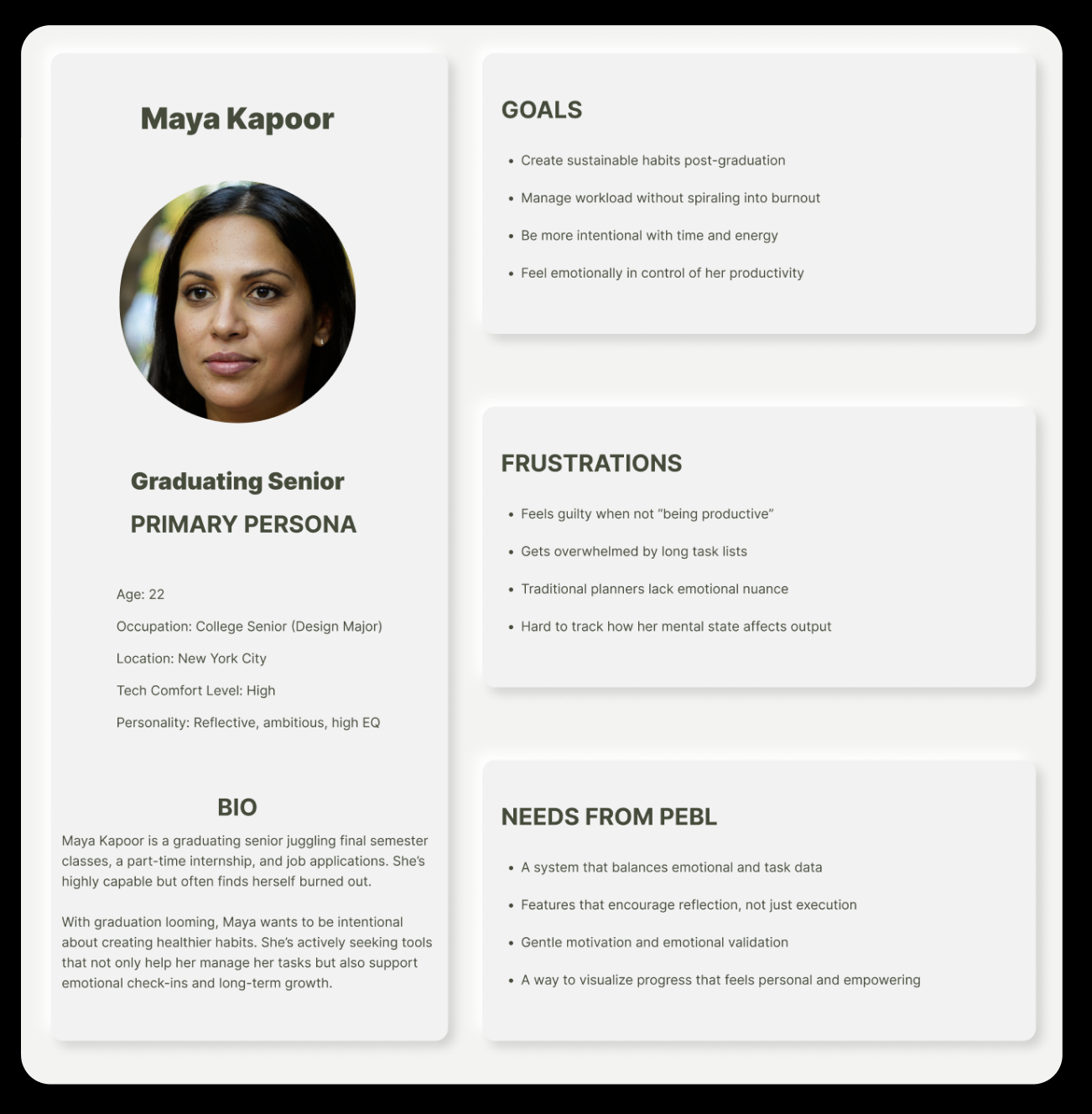
2. Persona Development
Primary persona: A high-achieving but overwhelmed student balancing goals with emotional inconsistency.
Key Needs:
Structure without pressure | Flexibility in task execution | Emotional validation alongside productivity
Structure without pressure | Flexibility in task execution | Emotional validation alongside productivity
3. Information Architecture
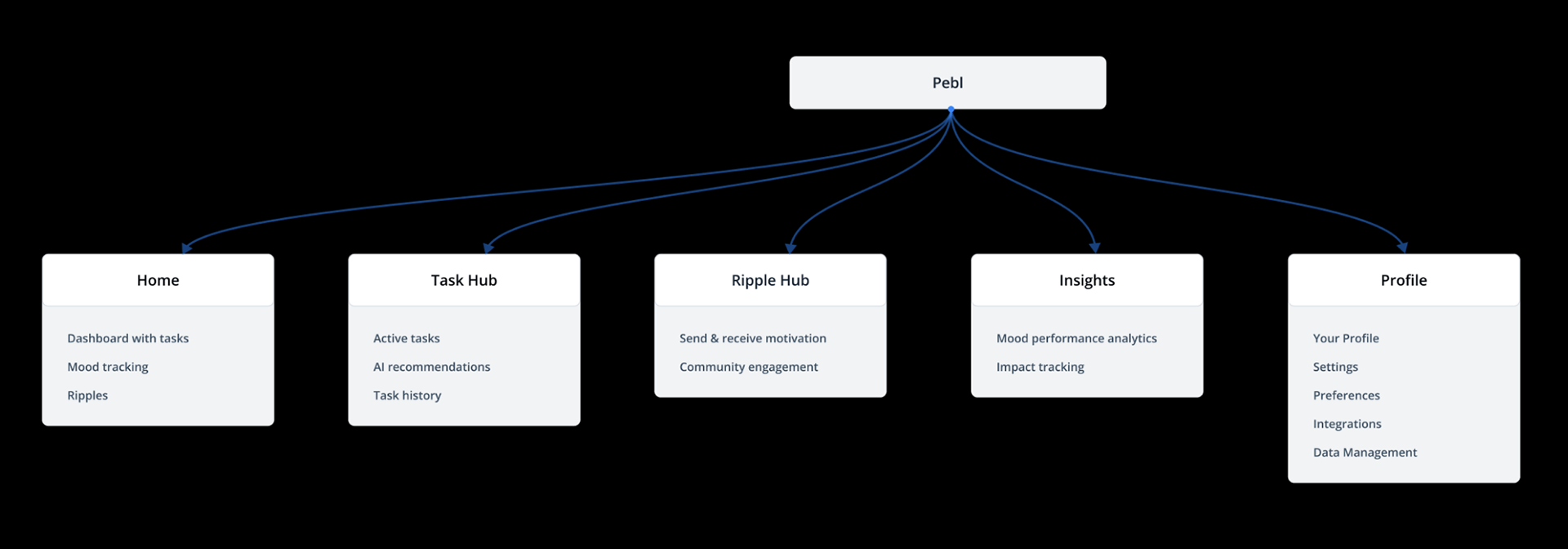
IA structured Pebl into 5 core systems:
Home (daily state & progress) | Task Hub (execution layer) | Ripple Hub (community motivation) | Insights (analytics & reflection) | Profile (customization)
Decision: Separated thinking (insights) from doing (tasks) to reduce friction.
4. Flow Design
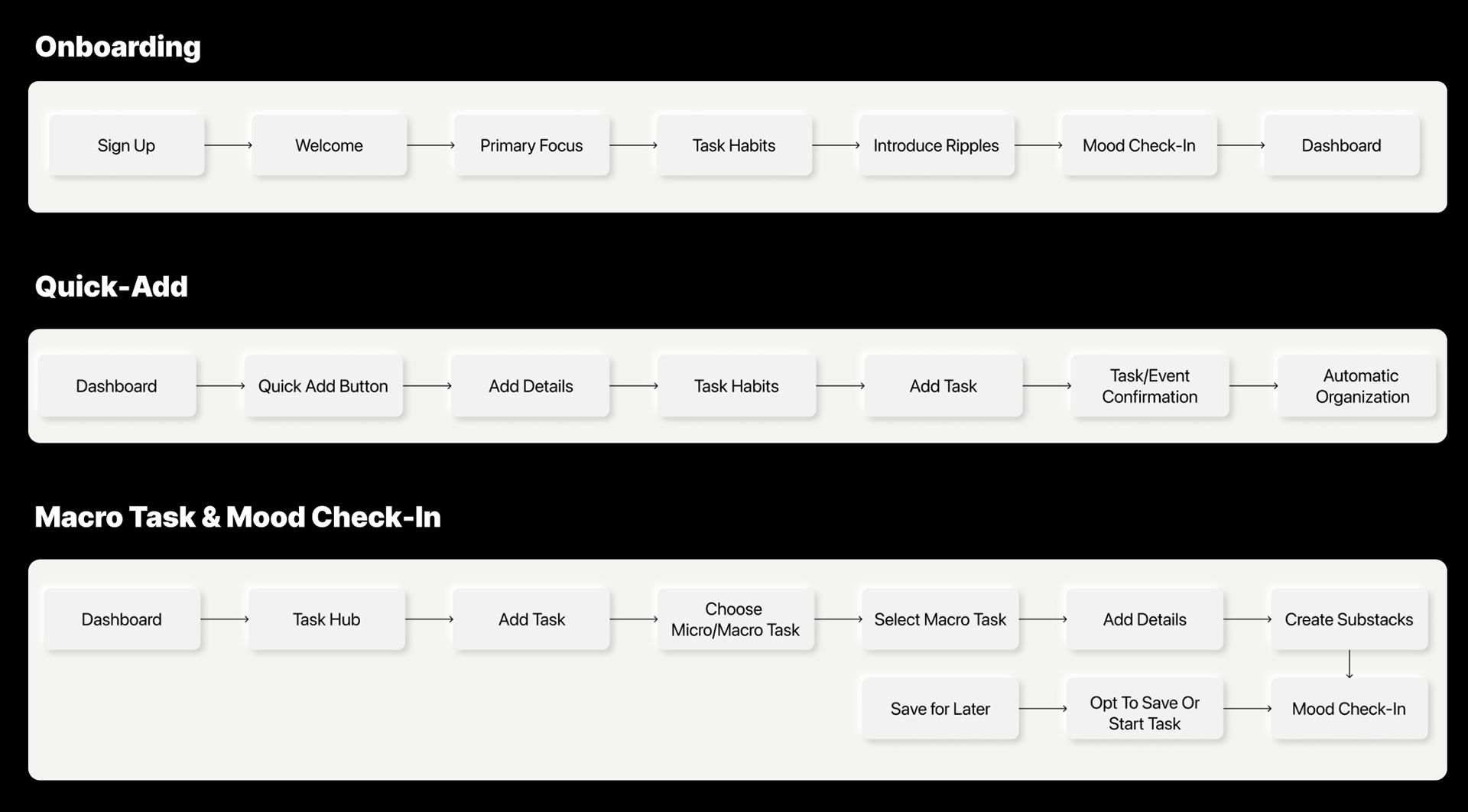
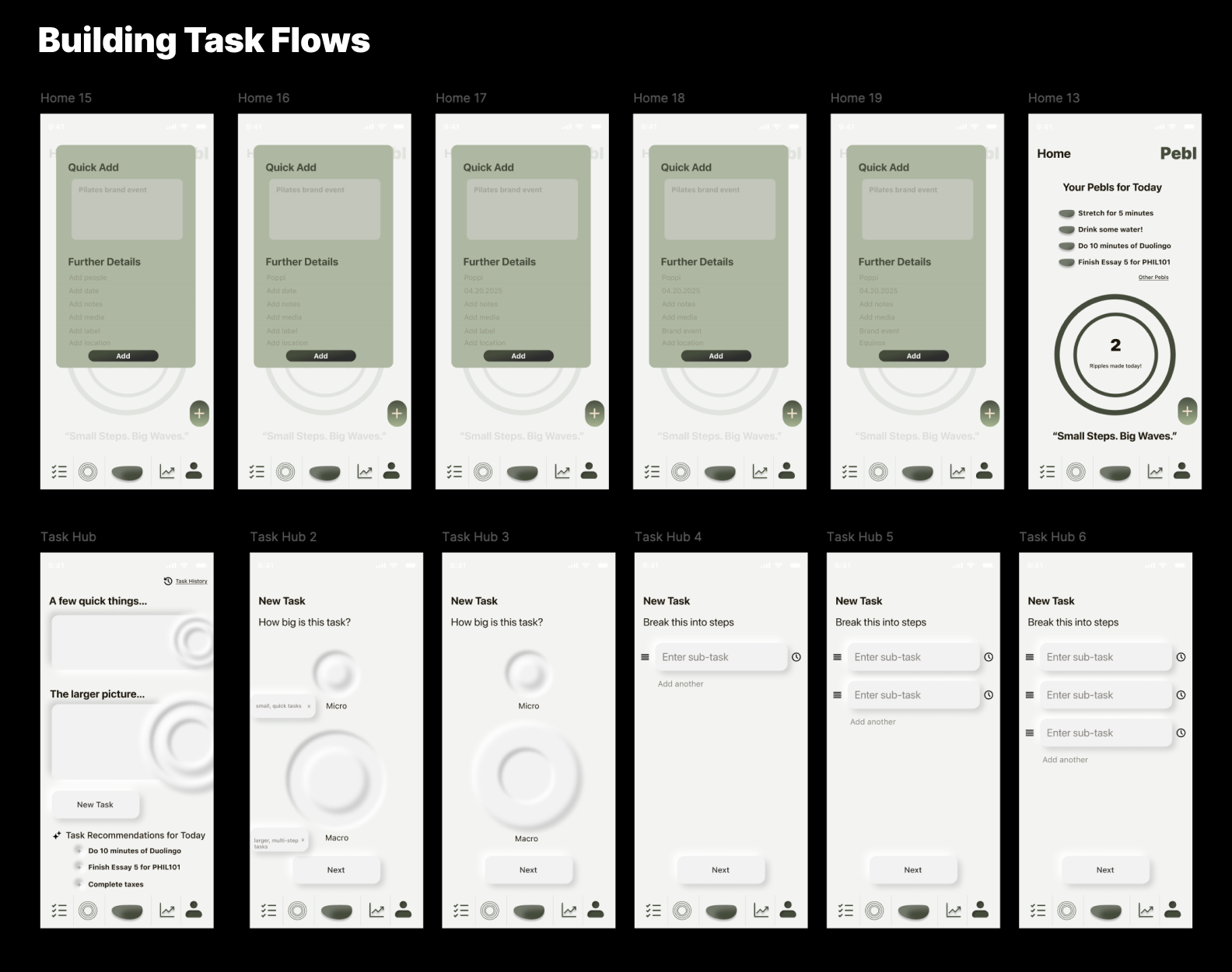
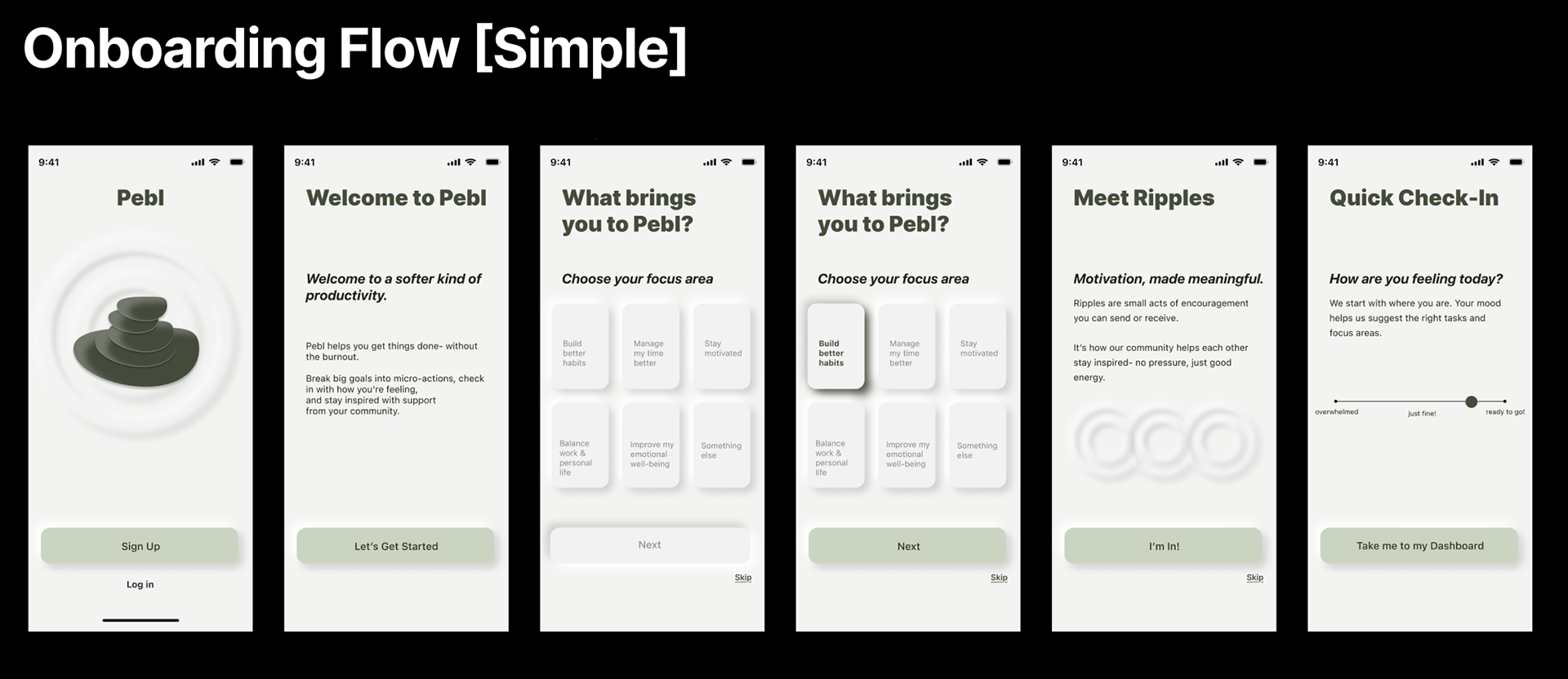
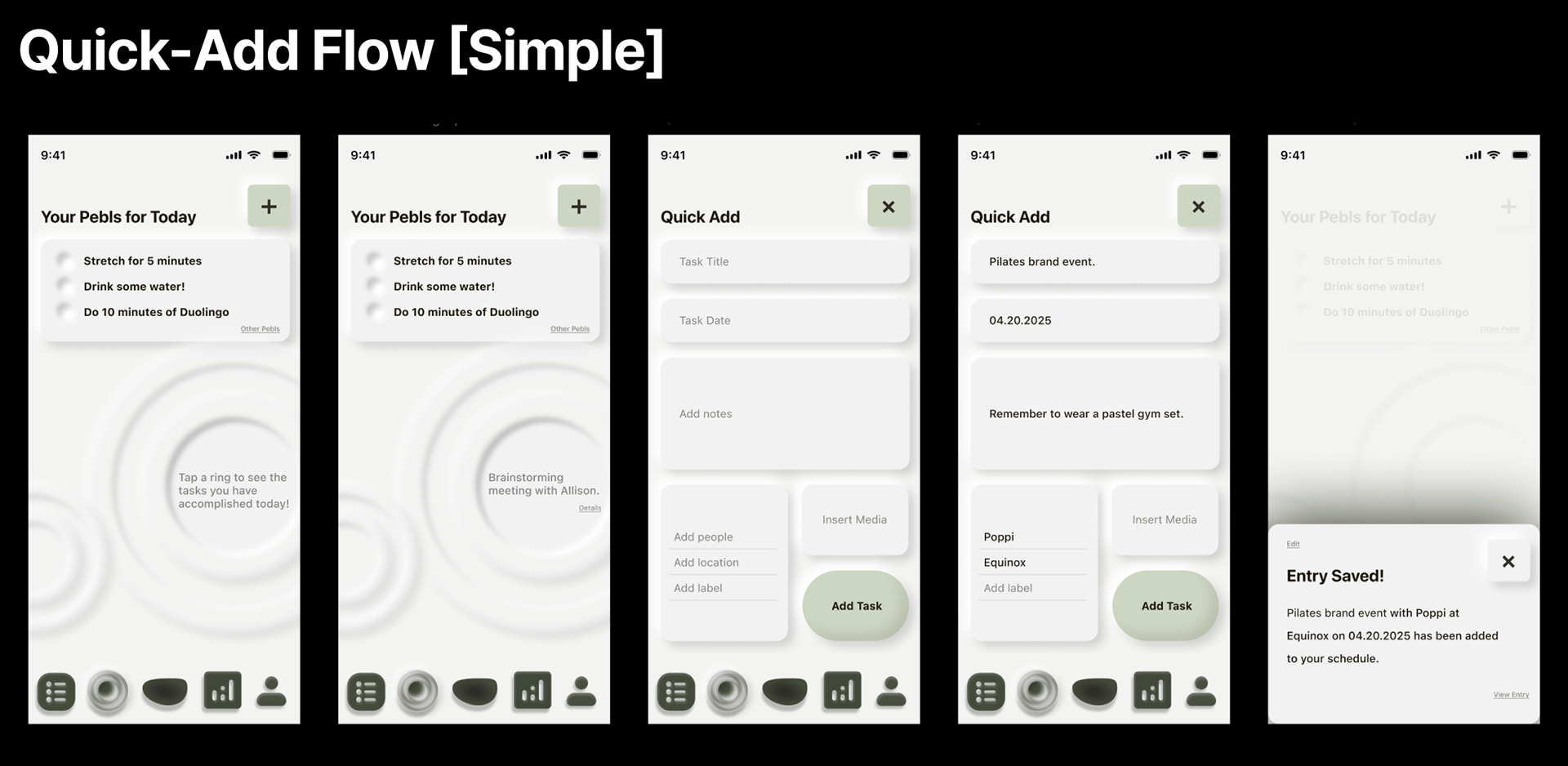
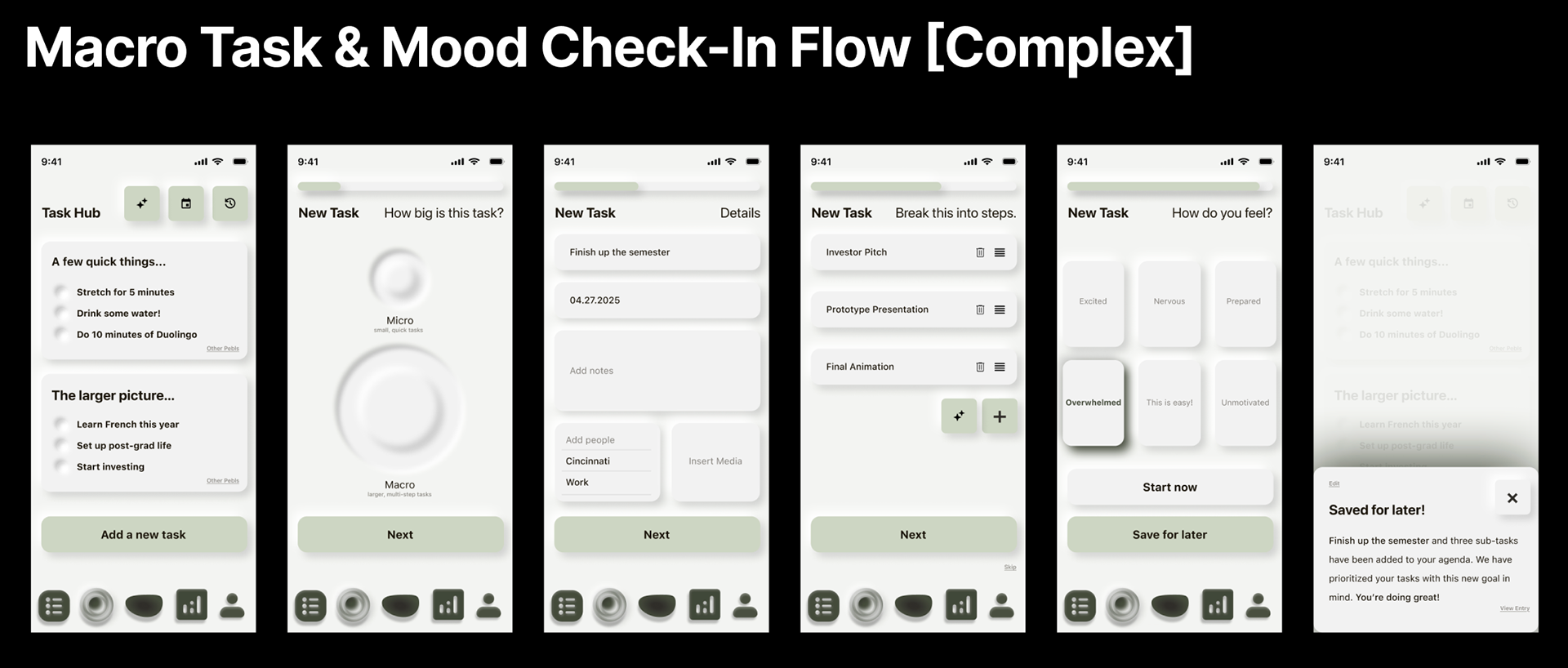
Three core flows were designed:
1. Onboarding Flow: Captures intent, habits, and emotional baseline. Sets up personalization early.
2. Quick-Add Flow: Reduces task entry to seconds. Minimizes friction during low-motivation states
3. Macro Task & Mood Flow: Breaks large tasks into smaller units. Integrates mood check-ins during execution
Measured UX Improvement (Projected):
↓ Task creation time by 40-60% (via Quick Add simplification)
↓ abandonment of large tasks by 30% (through task scaling)
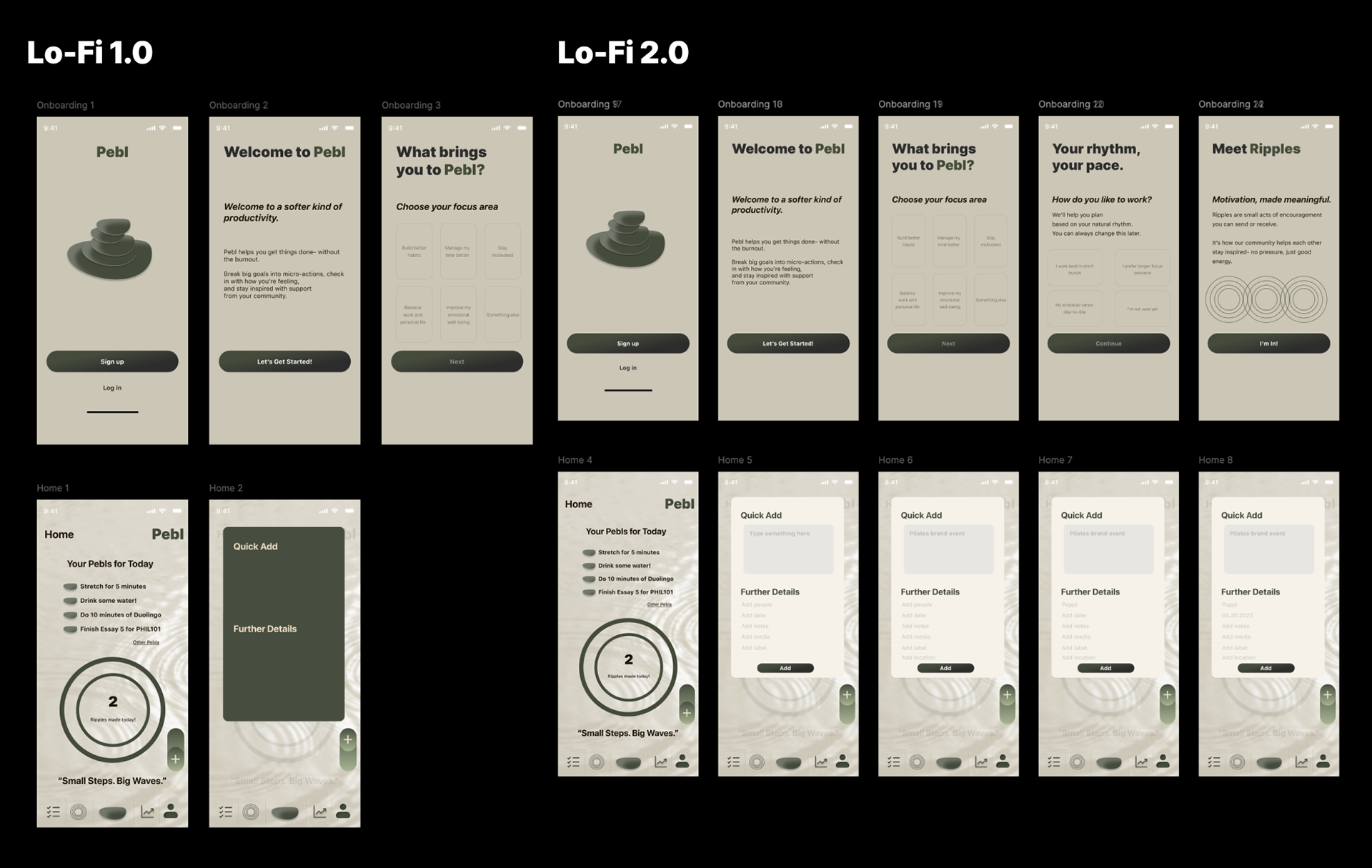
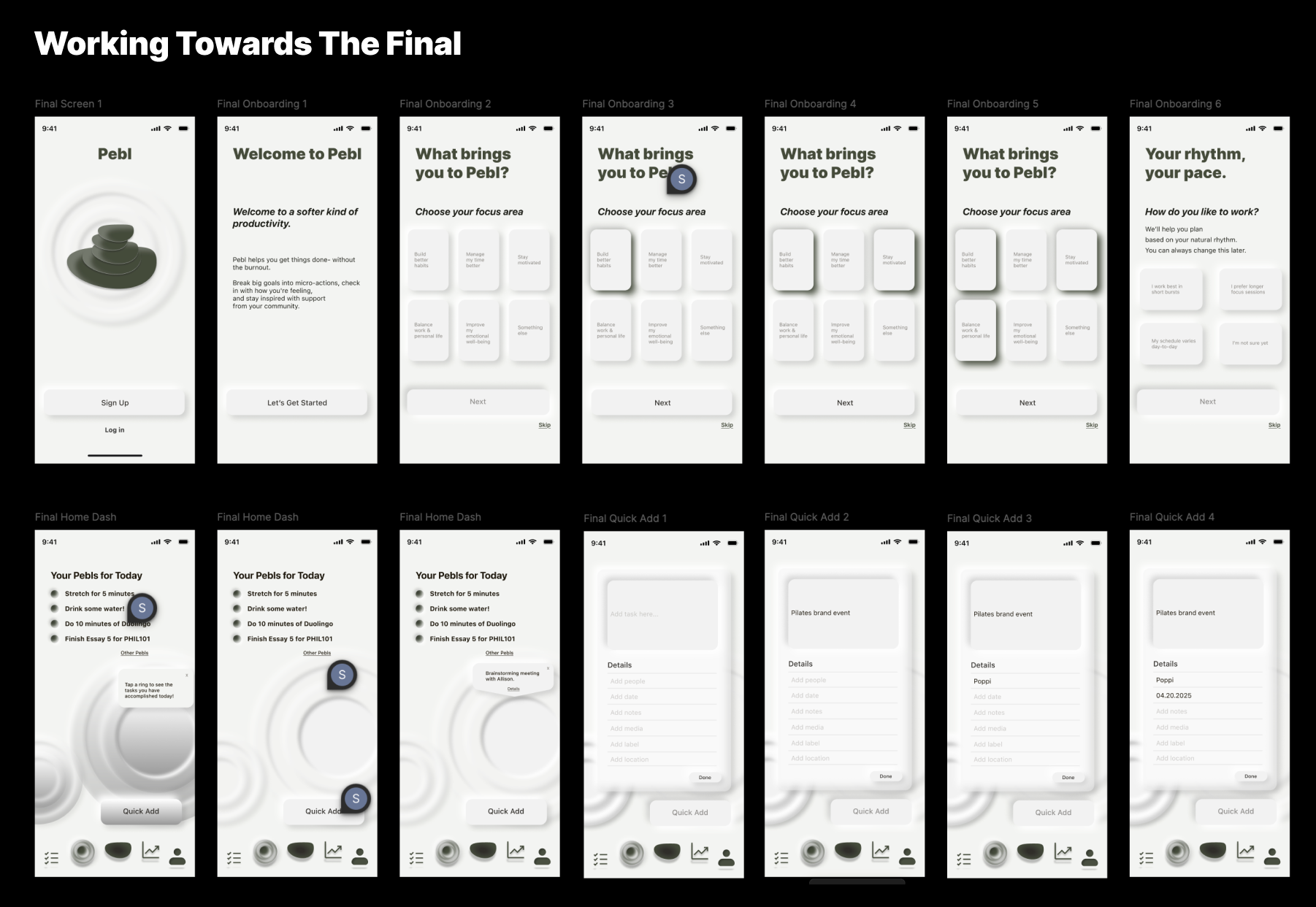
5. Iteration
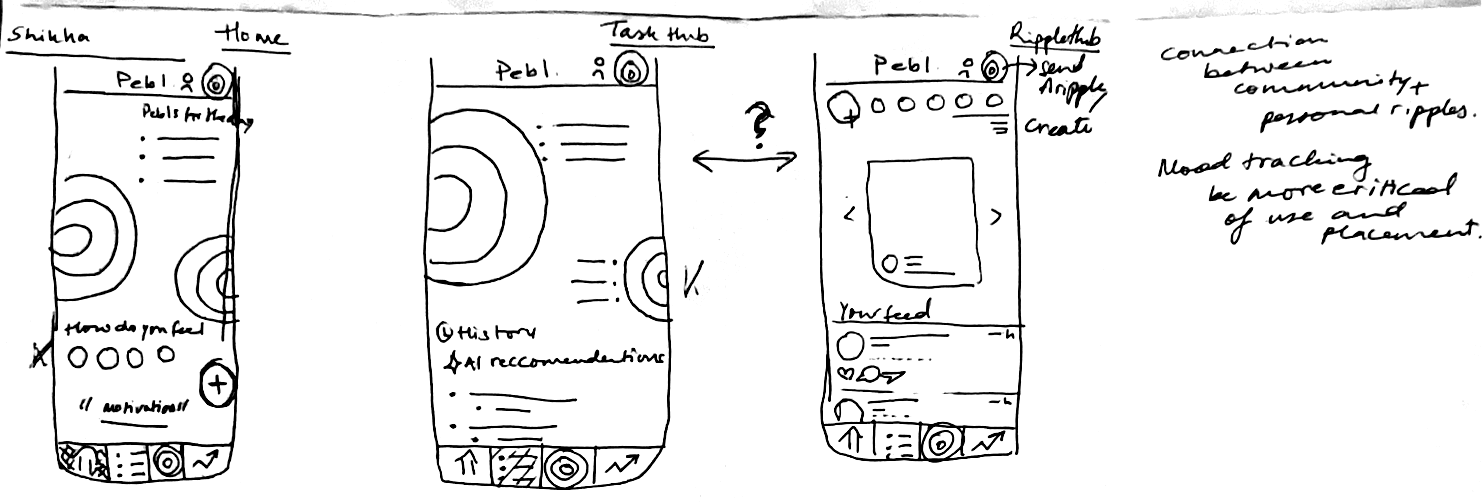
Progression: Low-fi sketches → structured flows → refined mid-fidelity digital designs
This helped bring clarity in layout and hierarchy.
Key Iteration Insight: Users engage more when progress feels visible and achievable, not abstract.
6. Visual Design Exploration
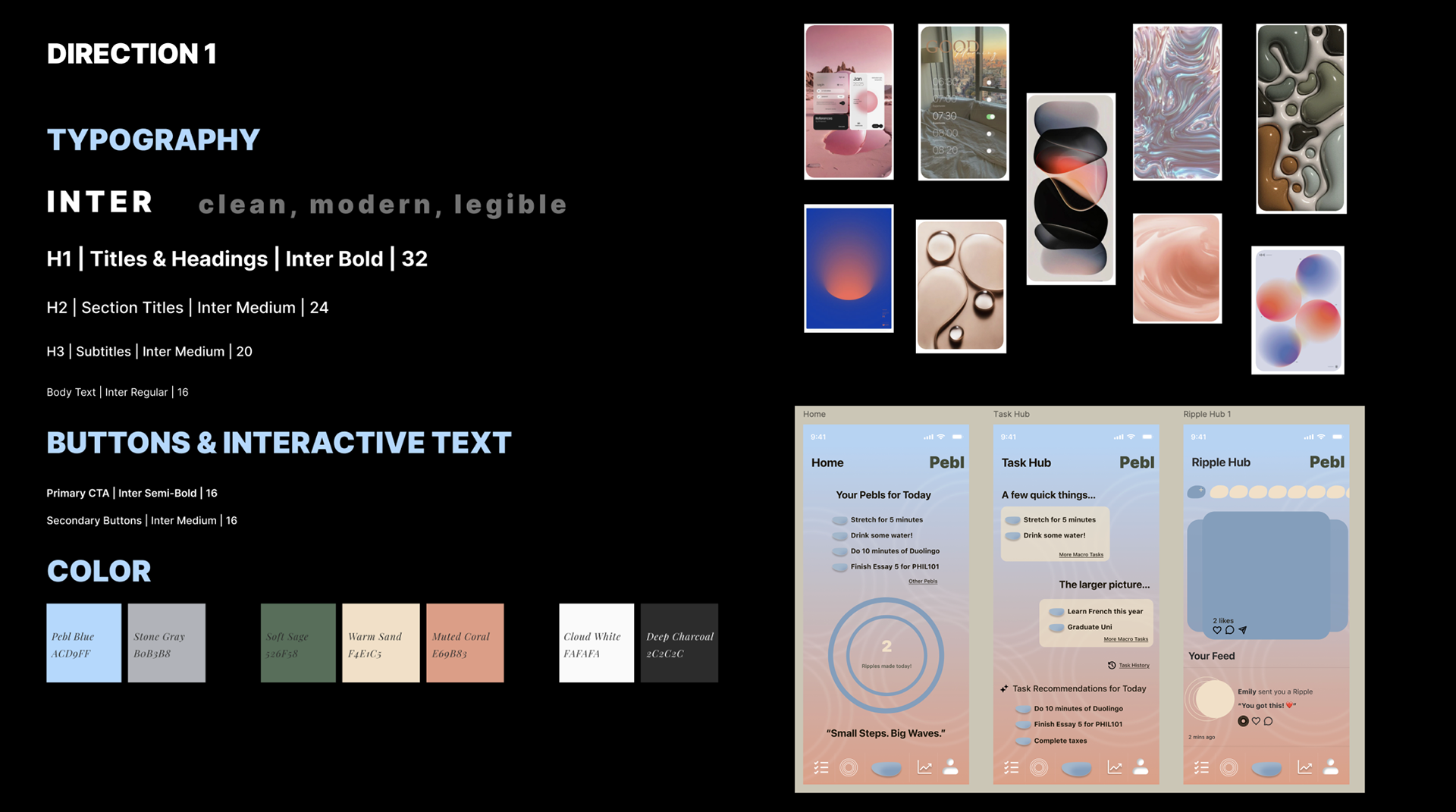
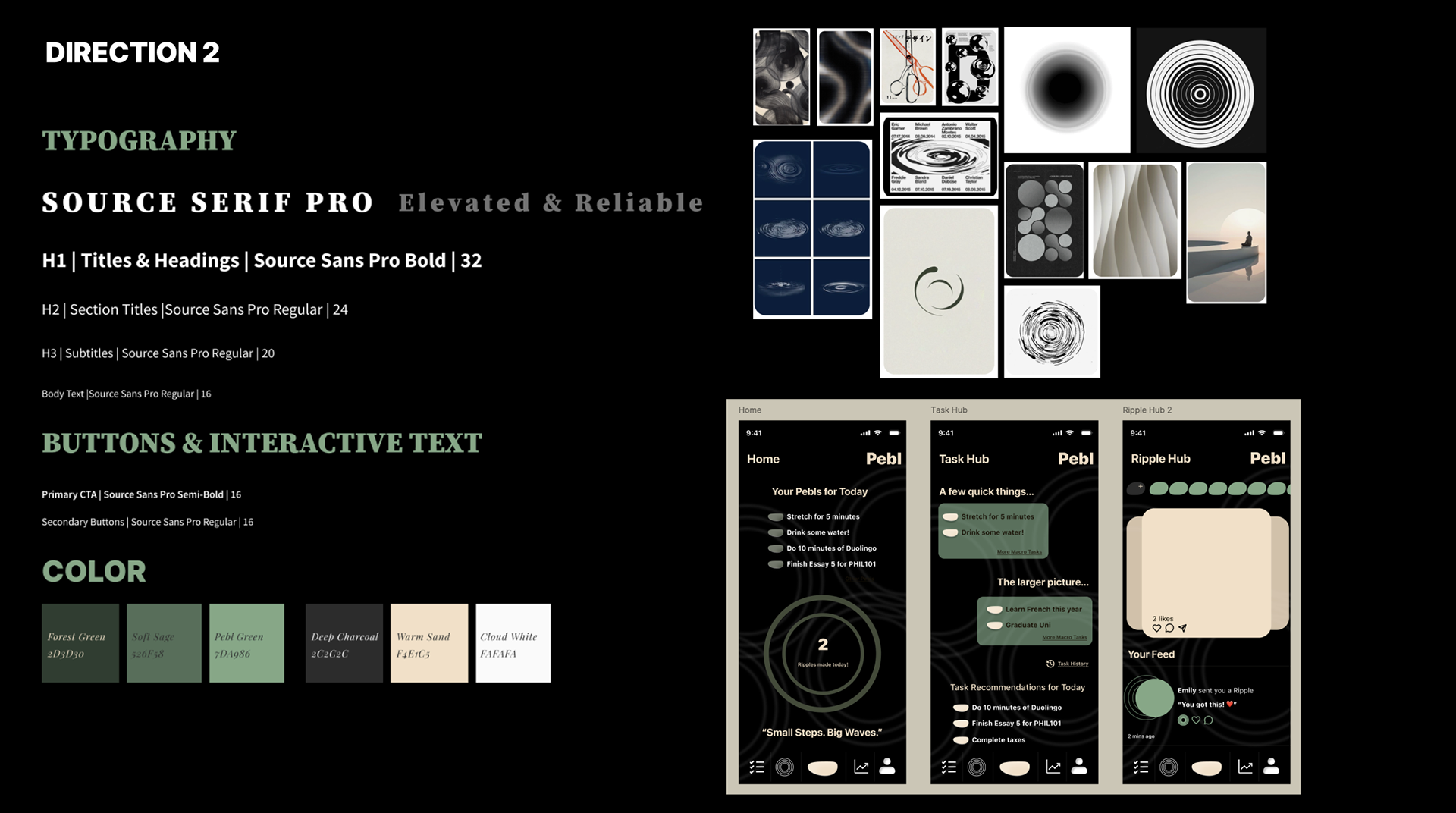
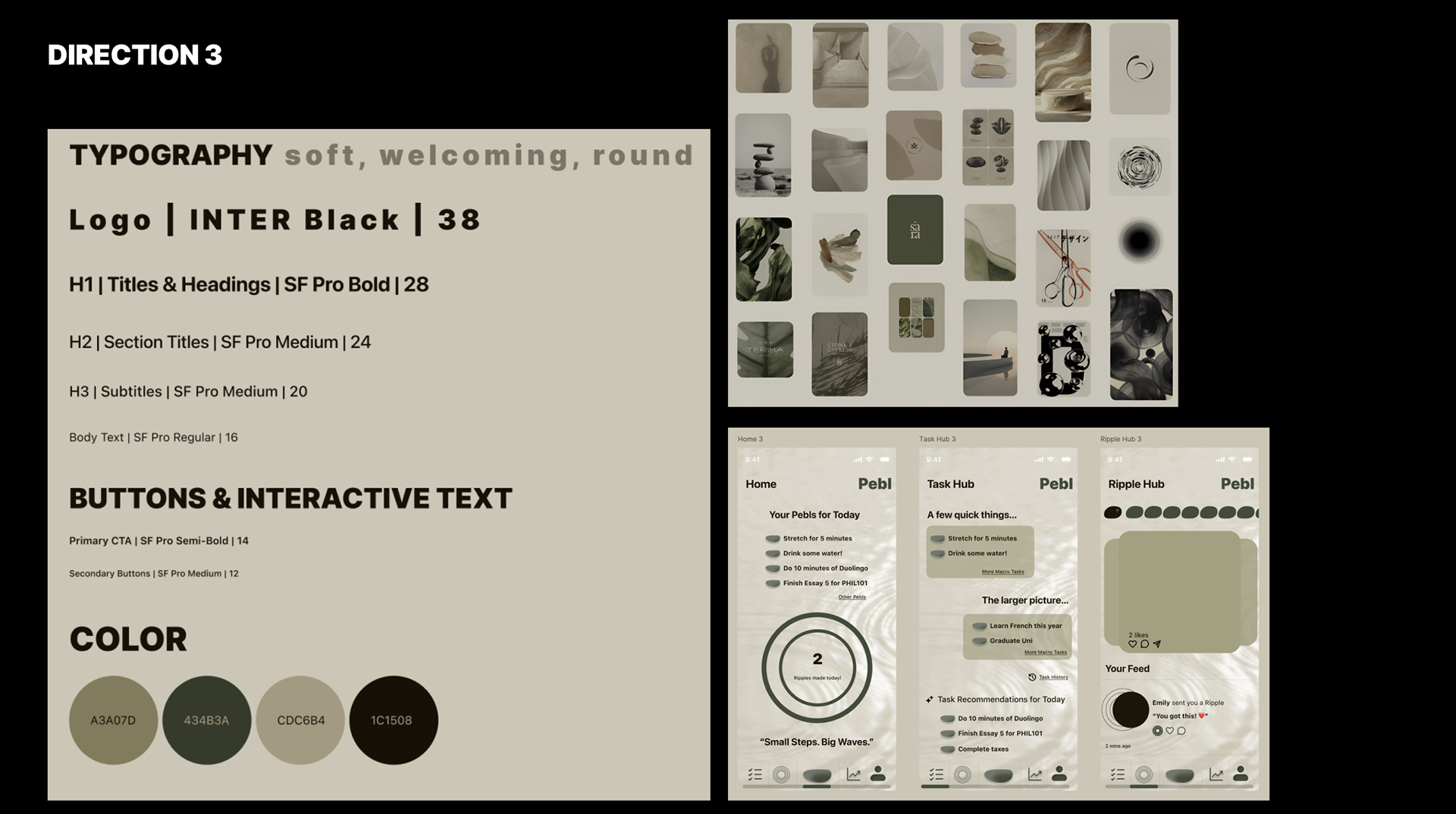
Three directions explored:
Direction 1: Light, gradient-based, optimistic
Direction 2: Dark, high-contrast, focused
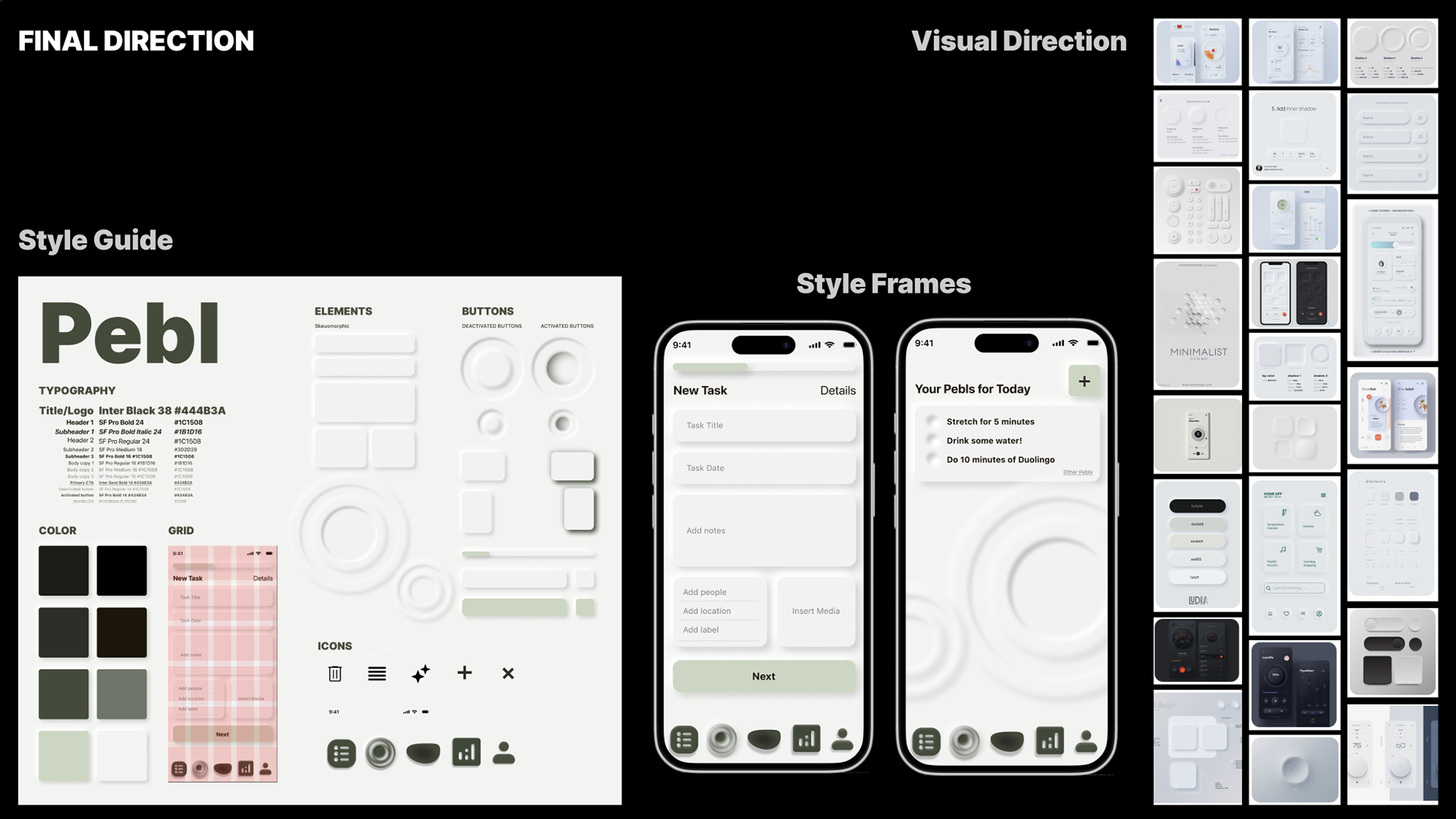
Direction 3 (Final): Neutral, calming, human-centered
Final direction emphasizes: Soft UI | Reduced visual noise | Emotional neutrality | Humanistic typography
Key Decisions
1. Adaptive Task Scaling
Instead of static task lists, tasks adapt through micro/macro modes and suggested task breakdowns.
This reduces overwhelm at the moment of action.
2. Mood as an Input, Not an Afterthought
Mood check-ins are integrated into flows, not separate features.
This makes the system responsive rather than reflective.
This makes the system responsive rather than reflective.
3. Ripple System (Community Layer)
Users can send/receive encouragement and engage in low-pressure social motivation.
In this case, external accountability increases consistency without pressure.
4. “Small Steps, Big Waves” Progress Model
Visual metaphor reinforces incremental progress and emotional reward.
5. Reduced Interface Complexity
Minimal inputs | Guided actions | Clear hierarchy
These three guidelines ensures minimal user friction; cognitive ease directly impacts retention.
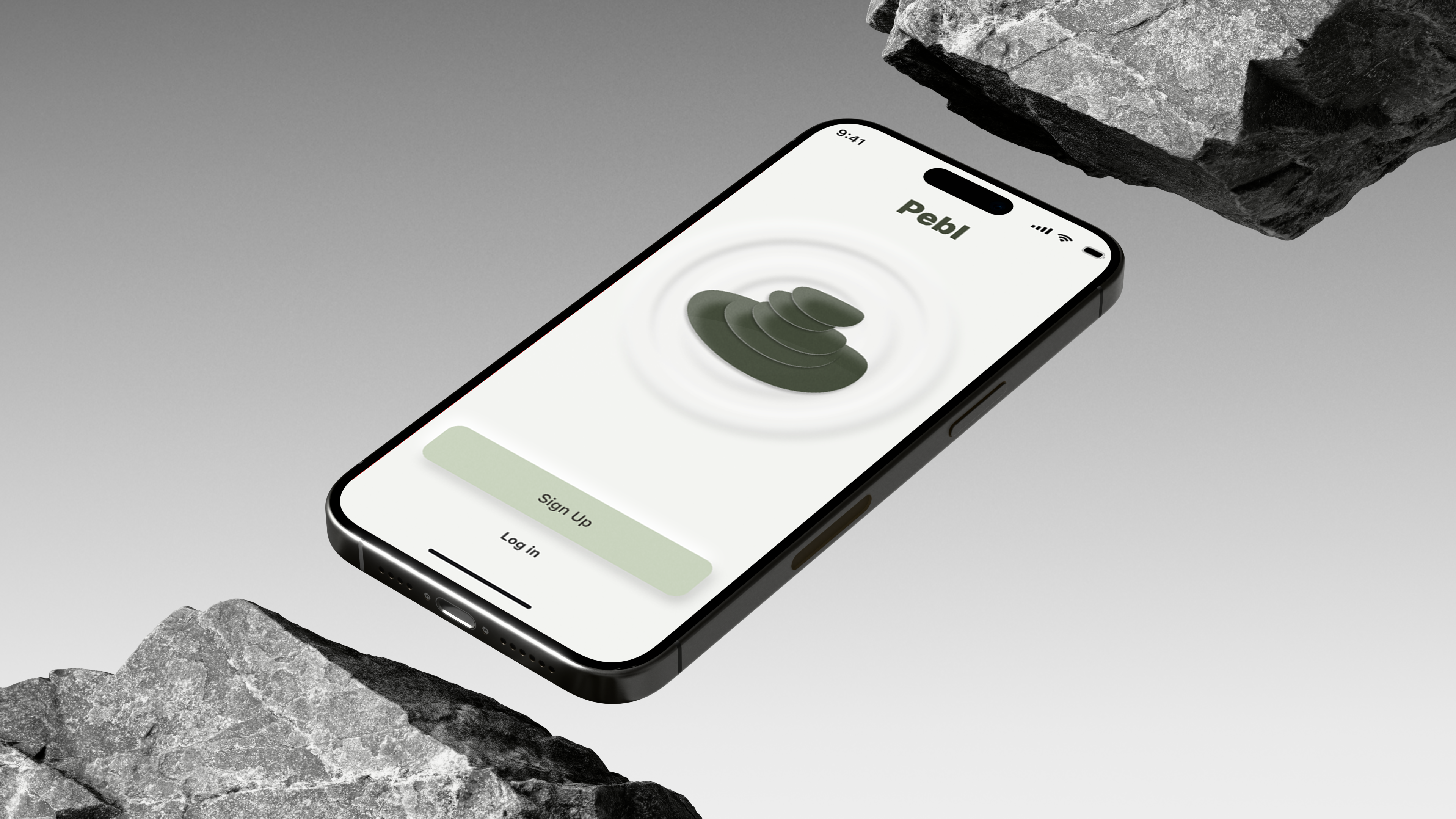
FINAL PEBL PROTOTYPE VIDEO
Outcomes
User Experience Impact (Projected)
↑ Engagement:
Emotional integration encourages daily interaction vs. task avoidance.
Emotional integration encourages daily interaction vs. task avoidance.
↑ Task Completion Rates:
Adaptive scaling reduces friction in starting tasks.
Adaptive scaling reduces friction in starting tasks.
↓ Drop-off Rates:
Simplified flows & quick add reduce abandonment.
Simplified flows & quick add reduce abandonment.
↑ Retention Potential:
System supports inconsistent users rather than penalizing them.
System supports inconsistent users rather than penalizing them.
Product-Level Value
Pebl shifts productivity from task completion to behavior shaping.
It becomes a system that adapts, a tool that responds, and a genuine experience that supports the user.
Reflections
1. Productivity is Emotional Infrastructure
When tackling productivity issues, most of it stems from emotions rather than logical solution-driven support. Therefore a sustainable system for this problem focused on emotionally supportive solutions rather than direction-based logical ones.
2. Simplicity was a Strategic Choice
Reducing features did not become a limitation but became Pebl's core UX strategy.
3. Systems Thinking > Feature Thinking
Pebl works because mood tracking, tasks and community features were interconnected and not isolated features.
4. Opportunity for Future Development
Real-time adaptive AI recommendations
Deeper behavioral analytics
More comprehensive habit tracking
Social network scaling within Ripple